Extrusion gives you the cross-section. It does not give you the holes, the bends, the threads or the finish. Those are secondary operations — the fabrication steps that turn a straight length of aluminum into the bracket, frame, rail or housing it was meant to be. Knowing which ones a part needs, and in what order, is most of the cost and most of the risk in an aluminum extrusion job.
The short answer
After extrusion and aging, a 6061/6063 profile is typically cut to length, then CNC machined (drilled, tapped, slotted, sometimes milled into a non-standard shape), then bent or welded if the geometry demands it, then finished — anodized, powder-coated or plated. The order matters: you machine before you bend, and you almost always finish last, because machining after anodizing simply cuts the anodized layer away.
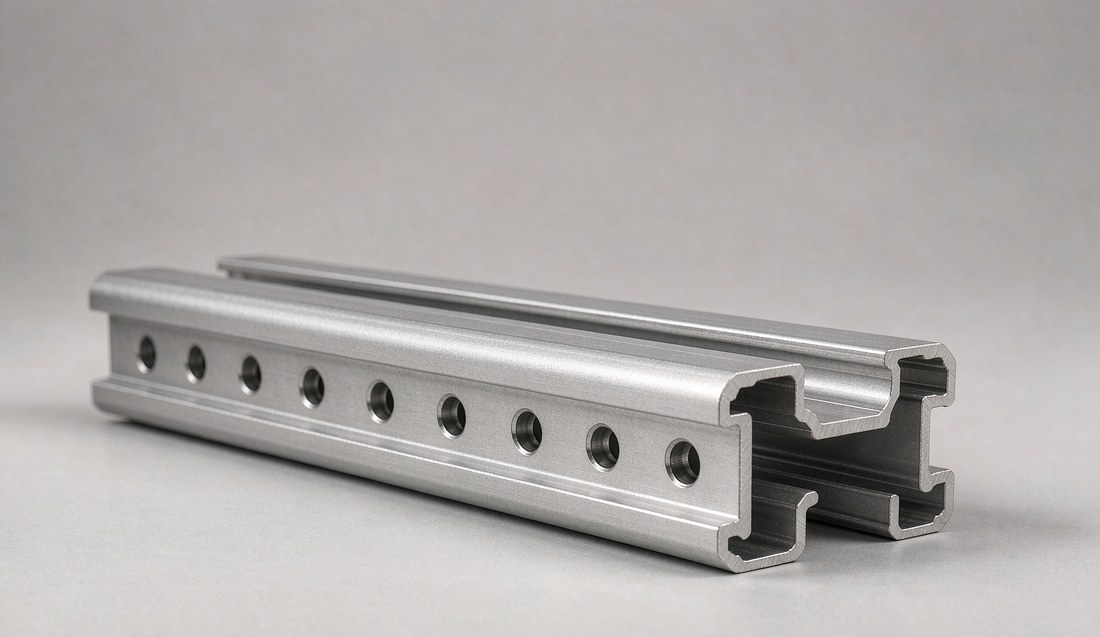
The secondary operations, in the order they usually happen
This is the typical sequence on a fabricated aluminum profile. Not every part needs every step — but when a step is needed, it almost always sits in roughly this order.
| Operation | What it does | You need it when… | Typical spec / limit |
|---|---|---|---|
| Cut to length | Saws the long extrusion to the finished length | The part is not a full bar | ±0.2–0.5 mm; mitre cuts for frames |
| CNC machining | Drills, taps, slots, mills holes and features | The profile needs holes, threads or a non-standard shape | ±0.05–0.1 mm with the right shop |
| Bending | Curves a straight profile into an arc or angle | The part is not straight (or is a frame corner) | Min radius ≈ 1.5–2× wall thickness |
| Welding / joining | Fuses profiles or attaches brackets | Sections must become one rigid assembly | TIG/MIG or friction stir; 6061 welds stronger |
| Inserts / fastening | Adds threads or captive hardware | Soft alloy can't hold a thread reliably | Helicoils, PEM, press-in T-nuts |
| Surface finishing | Anodize, powder coat, plate or brush | The part needs corrosion resistance or a look | Anodize 5–100 µm; powder 60–120 µm |
Cutting — getting the length right
The extrusion comes off the line in long lengths (often 3–6 m). The first real operation is almost always cutting to length — straight cuts on a saw, or mitre cuts when the profile forms a corner of a frame. A decent saw holds ±0.2–0.5 mm; if tighter length matters, it is usually controlled at the machining step instead. Cutting is cheap and fast; the mistakes here are mostly about burrs left on the cut face, which then have to be deburred.
CNC machining — holes, and the "custom-shaped" holes
Extrusion can only make a constant cross-section. Every feature that breaks that rule — a hole through the wall, a thread, a slot, a pocket, a notch — is added by CNC machining after the profile is cut. This is where most buyers under-specify and then over-pay.
- Drilling. Round through-holes and blind holes are the everyday case — clearance holes for bolts, lightening holes, locating holes. Usually the cheapest machining step.
- Tapping. Cutting a thread into the hole so a bolt screws straight in. Works well in 6061; in soft 6063 thin walls it can strip, which is why inserts exist (see below).
- Custom-shaped holes (异形孔). Not every hole is round. Slots, keyways, obround and rectangular cutouts, or a profile-shaped aperture that a drill simply cannot make, are produced by milling — a CNC end mill tracing the contour. This is the step that turns a "standard profile" into a part that only fits your assembly. Expect it to cost more than drilling, because it is a 2D or 3D milling path, not a single spindle plunge.
- Milling pockets and notches. Local material removal to clear a component, lighten the part, or create a seat for another piece. Often combined with the hole operations in one setup.
- Reaming / boring. When a hole must hold a bearing or pin to a tight tolerance, it is drilled undersize and then reamed.
Bending — curves from a straight profile
Extrusion is straight. If the part is an arc, a curve, or a framed corner that is not a welded joint, it is bent — typically on a rotary-draw bender (for tight, accurate radii) or a press brake with a shaped die (for gentle curves and angles). Bending looks simple and is where thin-wall profiles fail.
- Minimum bend radius. Roughly 1.5–2× the wall thickness for a solid leg; more for thin or hollow sections, because the inner wall wants to wrinkle and the outer wall wants to crack. Ask for a radius tighter than the alloy and wall allow and you get a scrapped part.
- Springback. Aluminum springs back after bending, so the tool is set past the target angle and allowed to relax. A shop that bends regularly knows the springback for 6061/6063; a shop that does not will hand you a part at the wrong angle.
- Wall stability. Hollow and thin-wall profiles need fillers or careful tooling to bend without collapse. This is a real capability differentiator between benders.
Welding and joining
6061 and 6063 both weld, but differently. 6061 welds to a stronger joint (it is the structural alloy) and is the choice when the weld carries load. 6063 welds easily but the joint is softer and the alloy is chosen more for its shape and finish than its weld strength. Process is usually TIG for appearance, MIG for speed, or friction-stir welding for long, high-quality seams.
The critical sequencing rule: an anodized or powder-coated profile cannot be welded afterward — the coating must be stripped at the weld, and the weld zone will not match the surrounding finish. Weld first, finish last.
Inserts and fastening
Soft aluminum does not hold a machine thread forever, especially in thin walls or in 6063. The fix is to put the thread somewhere more durable:
- Helical inserts (Helicoil / wire thread insert). A steel thread bonded into the aluminum hole — the standard answer for bolts that are repeatedly removed.
- Press-in / PEM-style inserts. A clinched or pressed boss that becomes the load-carrying thread.
- T-slot nuts and captive hardware. For framing systems, the nut runs in the slot rather than being tapped into the wall at all.
Specifying inserts adds a step but saves a field failure. Where a thread is structural, it is almost always the right call.
Surface treatment — the finish
This is the last operation and the most visible. The common finishes on extruded aluminum:
- Anodizing (氧化). An electrochemical conversion of the surface into a hard oxide layer — integral with the metal, so it does not add measurable thickness and does not peel. Type II is the decorative clear or dyed finish (5–25 µm); Type III / hardcoat is thick and wear-resistant (up to ~50–100 µm). Anodize is the reason 6063 is the default for visible trim — it takes a clean, even color. It is done last, after all machining.
- Powder coating. Electrostatic paint baked on — any color, 60–120 µm, hides surface imperfections and is very corrosion-resistant. Thicker than anodize, so it can affect fits; specify it before critical dimensions are cut if the part must mate tightly.
- Liquid paint / electrophoretic (ED) coating. Wet paint for special colors or ED primer for uniform coverage in recesses.
- Plating (电镀). Chrome, nickel or a stainless look. Plating aluminum is not like plating steel: a direct plate blisters and peels. It needs a zincate or electroless-nickel barrier layer first, then the final deposit. It is a real process, but it is a specialist one — budget for the extra prep step and verify the shop actually plates aluminum.
- Brushed / polished / sublimated. Mechanical or printed finishes — brushed satin, mirror polish, or wood-grain sublimation onto a coated profile for architectural use.
The four traps that cost buyers money
These are the ones that surface after the drawing is released and the line is running — when they are expensive to unwind.
- Anodizing before machining. Machine a hole after anodizing and you simply cut through the oxide back to bare metal — the feature is no longer protected and no longer matches. Machine first, anodize last. The same trap applies to welding.
- Plating aluminum with no barrier layer. A shop that plates "like steel" will hand back a part whose chrome blisters within months. Aluminum needs a zincate or electroless-nickel strike first. Specify it, or the finish will fail in the field.
- Bend radius too tight for the wall. Asking a thin or hollow leg to take a radius below roughly 1.5× its wall thickness produces wrinkling or cracking. The part is either scrapped or quietly weakened. Set the radius from the alloy and wall, not from the drawing's look.
- Tapping soft 6063 walls. A thread cut into a thin 6063 wall strips on the second bolt. Move the load to a Helicoil or pressed insert and the joint becomes reliable. This is a drawing decision, not a shop fix.
So which operations does your part need?
- Just a length with a few bolt holes → cut + drill. Minimal cost.
- Holes that are not round (slots, keyways, shaped apertures) → cut + CNC milling for the custom features.
- A curved or angled part → add bending; respect the minimum radius for the wall.
- Sections that must become one rigid piece → weld, then plan to finish last.
- Threads that are removed repeatedly or carry load → specify inserts, not tapped aluminum.
- Visible, corrosion-resistant or colored finish → anodize (thin, durable) or powder coat (any color, thicker); plate only with the proper aluminum prep.
The cheapest part is the one whose extruded shape already does most of the work, so machining and finishing only add what the profile genuinely cannot. That is a design choice made before the die is cut — which is where a DFM review pays for itself.
Where I fit in
I sit between you and the extrusion mill and the machining shop, so the secondary operations are planned as one job rather than discovered after the fact: the profile is designed to minimize machining, the bend radii are set to the wall, the finish is specified before critical dimensions are cut, and the whole thing is matched to a shop that actually does the operations your part needs. See the fuller picture:
Read: aluminum extrusion in China — dies, profiles and secondary ops →
Read: CNC machining in China — tiers, tolerances and the cheap-quote trap →
Read: die-cast ADC12 vs extruded 6061/6063 — which material →
Read: DFM checklist before you send a drawing to China →
See the four capability domains →
Send a drawing — I'll plan the fabrication steps and the finish →